Codility and HackerRank are both ways to test coding skill at scale, but they tend to answer different hiring questions. They work best as signals, not verdicts. If you add work-sample evidence and, when appropriate, a recorded live session, you can test delivery, collaboration, and judgement with fewer guesses.
Codility vs HackerRank: what’s the real difference?
They are both standardised coding assessments, but they often emphasise different slices of performance. The difference that matters is not the brand. It is what the format makes easy to observe, and what it makes hard to observe.
A timed coding test is good at showing whether someone can produce a correct solution under constraints. It does this by fixing the prompt, limiting time, and requiring a clear output. It is weaker at showing how someone works through ambiguity, feedback, and an existing codebase, because those conditions are hard to recreate in a short, standardised task.
Codility is often chosen when you want a structured, comparable screen. That choice usually reflects a need for consistency and simple administration. HackerRank is often chosen when you want a broader mix of question styles, or to run challenges and practice. Either can be set up well or badly, depending on role fit and the task design.
If you want vendor-specific notes, Lemma keeps separate comparison pages: /compare/codility and /compare/hackerrank.
| Decision focus | Standardised coding test tends to show | Often misses | Best companion evidence |
|---|---|---|---|
| Screen large volumes | Baseline coding under time pressure | Role-specific judgement | Short work sample aligned to your stack |
| Compare candidates fairly | Same prompt and constraints | Different working styles | Structured rubric and reviewer calibration |
| Reduce interviewer load | Defined outputs you can score | Collaboration and reasoning | Short live problem-solving walkthrough |
What do these platforms actually test well?
They test whether a candidate can turn a problem statement into working code within the given constraints. They do this by standardising the environment, so you can compare results more easily than with ad-hoc interviews.
Most coding tests reward a specific set of behaviours. You read carefully, pick an approach quickly, implement with few mistakes, and debug under pressure. That is a real skill. It can also favour people who have practised similar tasks recently, because speed and familiarity matter in timed settings.
They are also useful for checking fundamentals without an interviewer in the loop. That mechanism reduces variance, because the candidate is not affected by an interviewer who hints, interrupts, or changes the goalposts.
Where teams overreach is using a generic test to predict performance in a very specific job. A puzzle-style task may not map well to maintaining a large codebase, reviewing pull requests, or working with product constraints. You get a clearer signal when you map each assessment step to a capability you actually need.
| Capability you care about | What a coding test can observe | What you need to add to observe it |
|---|---|---|
| Implementing correctly | Producing correct outputs | A small change in a realistic repo |
| Debugging | Fixing errors under time limits | A guided debugging task with discussion |
| Complexity judgement | Approach and trade-offs (sometimes) | “Why this approach?” follow-up |
| Communication | Very limited | Walkthrough of decisions and assumptions |
How do these tests feel to candidates, and why does that matter?
They often feel like a high-stakes, timed exam. That matters because candidate experience changes how representative the result is, especially for senior roles where the job rarely resembles an exam.
Timed environments can be fair in one sense: everyone gets the same constraints. They can be unfair in another: the constraint becomes the main challenge. You end up measuring speed and stress management as much as reasoning and correctness.
Candidates also read your assessment choice as a signal about your team. A heavy screening test can suggest you optimise for efficiency and consistency. A work-sample-first process can suggest you optimise for real-world fit. Neither is inherently better. You just want the signal you send to match the role.
If you use a coding test, you can reduce negative side effects by being explicit.
- Say what the test is for (screen, calibration, or verification).
- Say how you will use the result (threshold, ranking input, or discussion starter).
- Say what happens next (work sample, interview, or both).
This improves validity because candidates stop guessing what you want. It also improves fairness because you reduce hidden criteria.
| Candidate concern | What causes it | What you can do about it |
|---|---|---|
| “This isn’t like the job” | Generic tasks for specialist roles | Add a role-aligned work sample |
| “I froze under time pressure” | Tight timers, unfamiliar UI | Use multiple signals, add a walkthrough |
| “I can’t show how I work” | Only the final output is seen | Ask for reasoning and trade-offs |
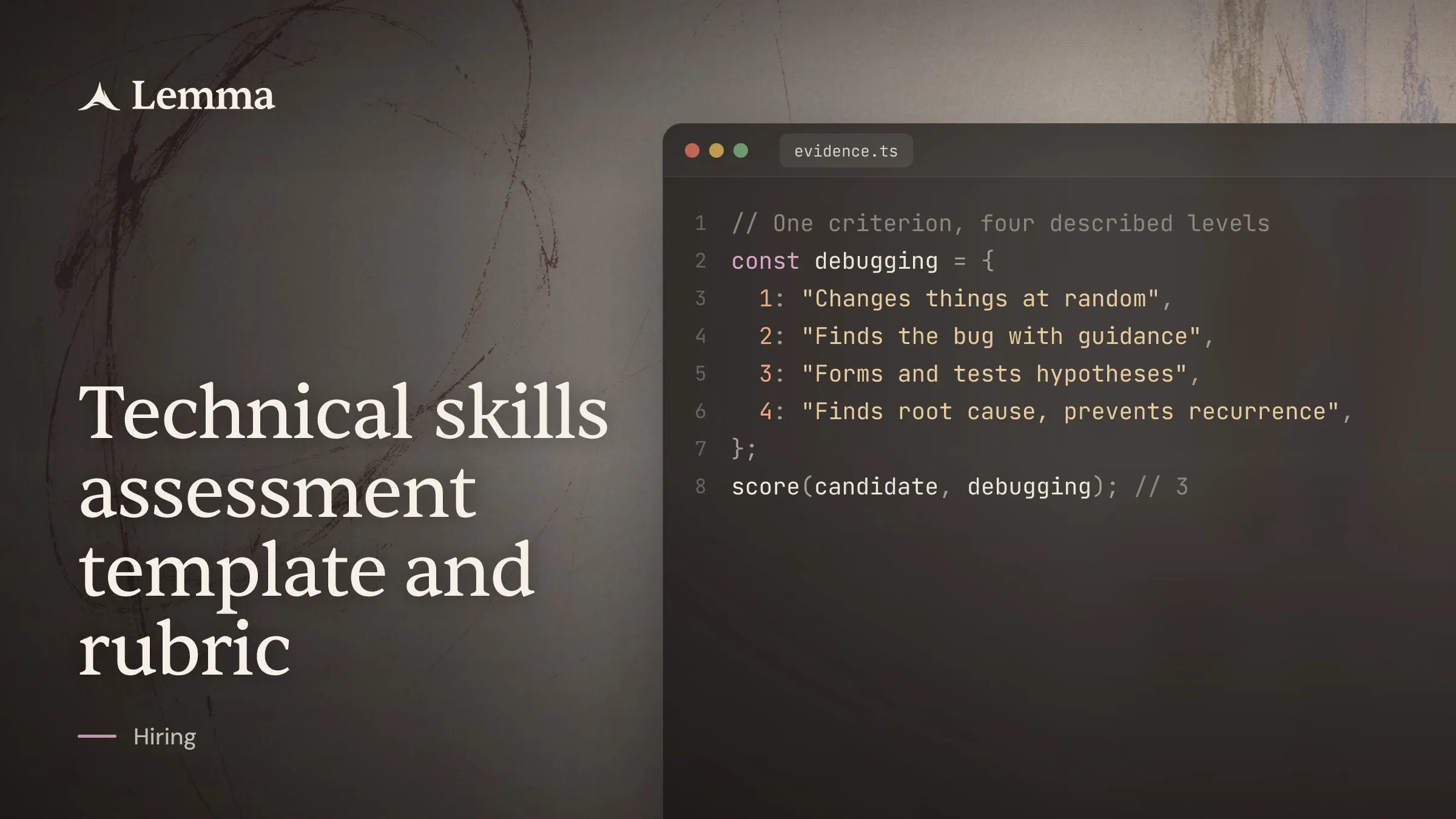
If you are designing your own process, a practical rubric helps keep reviewers aligned. The templates in /blog/technical-skills-assessment-template and /blog/assess-technical-skills-in-interview are good starting points.
When is a work sample better than a coding test?
A work sample is better when you care about delivery in conditions closer to the job. It works by moving the assessment from abstract problems to realistic constraints: your stack, your standards, and your trade-offs.
A work sample can be small and time-boxed. For example: add a feature behind a flag, fix a bug with a regression test, or refactor a module for readability. What makes it a work sample is that it resembles real work products and review criteria. You review what they produced, not only whether it passed hidden tests.
Work samples are strongest when your hiring question is about judgement.
- Do they make sensible trade-offs?
- Do they communicate assumptions and ask useful questions?
- Do they leave the code easier to work with than before?
Work samples do have costs. They take reviewer time, and they can become subjective if expectations are not written down. You manage that with a rubric and reviewer calibration, which makes “good” concrete before you look at candidates.
| Hiring stage | Coding test helps when | Work sample helps when | A common pattern |
|---|---|---|---|
| Early screen | Many applicants, need a baseline | Reviewer time is tight | Test first, sample later |
| Mid stage | You need a second data point | You want delivery style | Work sample as the main step |
| Final stage | You want another signal | You need role-fit confidence | Sample plus walkthrough |
Where do recorded live sessions and evidence-based records fit?
Recorded evidence helps when you need something you can inspect later, not just a pass/fail moment. It works by linking a skill claim to the events and artefacts that produced it, with dates and context.
On Lemma, five kinds of evidence count towards a skill record: live sessions, adaptive assessments, peer confirmations, external proofs (GitHub, Figma, Vercel) and AI tutor practice. Listing a skill adds nothing to its score; only recorded evidence does. This matters because it separates “what someone says” from “what they can show”. You can see the evidence types in context at /methodology#evidence-types.
Live sessions on Lemma are 30- or 60-minute video sessions booked against one skill. A session completes once both people have joined. Joining more than 15 minutes late counts as a no-show, and cancelling less than 24 hours before the start is a late cancellation. Those rules matter because reliability becomes part of the record, instead of a vague impression. Details are on /product/sessions.
Adaptive assessments on Lemma run on a 1 to 10 difficulty scale, ask between 15 and 25 questions, and stop once the level holds steady. Each question has a time limit and answers cannot be changed afterwards. Each person takes a different path through the questions, recently seen questions are not served again, and tab switches, pastes and developer tools are logged. Flags go to a person for review; they never cut a score automatically. Details are on /product/assessments.
Lemma organises this into a Skills Passport you can share as a link to the whole Passport or selected skills, keeping hidden skills hidden. The Passport document is signed, so a reader can confirm Lemma issued it and that it has not changed since. Evidence is append-only, so corrections, revocations and disputes are added as new events rather than erased. Background is on /product/passport and /product/sci.
| Evidence type (Lemma) | What it can show | Why it complements tests | Built-in limit to remember |
|---|---|---|---|
| Live sessions | Reasoning aloud, collaboration | Shows process, not just outputs | Late join/no-show rules; disputes are reviewed |
| Adaptive assessments | Timed skill across difficulty | Comparable measurement with integrity signals | 15–25 questions; flags reviewed by a person |
| External proofs | Real work artefacts tied to an account | Shows delivery in real tools | Two per skill count |
| AI tutor practice | Ongoing drills | Shows practice between higher-stakes evidence | Capped contribution within practice |
How do you choose between Codility, HackerRank, and work-sample evidence?
Choose based on the question you need answered, then pick the cheapest method that answers it reliably. It works when you separate “can they code?” from “will they succeed here?” and collect different evidence for each.
A simple decision flow helps. First, name the risk you are reducing: fundamentals, delivery, or integrity. Next, decide what you will do with the result: screen, prioritise, or verify. Finally, use at least two signals where you can, because one signal can fail for reasons unrelated to performance.
If you want a wider discussion of evidence-based hiring alongside traditional platforms, /blog/hackerrank-alternatives-evidence-based-hiring and /blog/what-is-skill-verification add useful context.
 ChatGPT
 Claude
 Perplexity