To show SQL skills on your resume, replace level labels with specific tasks you did, the query patterns you used, and the data context. Then attach one proof link per major claim, such as a repository commit, an assessment result, or a recorded live session. This makes your SQL easier to trust than “SQL: Advanced”.
What should you write instead of “SQL: Advanced” on a resume?
Write one or two lines that connect SQL to a real task, the query types you used, and the outcome. This turns “level” into something a reviewer can picture. It also gives them role-matching keywords, without forcing you into a self-graded label.
Start by picking the work you want to be hired for. SQL can mean dashboard queries, data modelling, backend reporting, experimentation, or performance debugging. A hiring manager reads “Advanced” as “unknown” because it does not describe what you can do.
Use a simple structure:
- Task: what you were trying to answer or build.
- Techniques: the SQL patterns you reached for.
- Context: what kind of data, in what shape.
- Outcome: what changed as a result.
Examples you can adapt (examples, not templates you must copy):
- “Built retention queries using window functions and CTEs; validated joins against event definitions.”
- “Modelled a reporting dataset with clear grain; documented join keys and common pitfalls.”
- “Partnered with an engineer to debug a slow report query; explained trade-offs and fixes.”
If you want a shared reference for what “SQL competence” includes, use a skill definition as a cross-check. Lemma’s SQL skill page is one option: /skills/sql.
Which SQL keywords tend to carry real meaning?
Use keywords that map to artefacts people recognise. They hint at what you can produce on day one.
| Resume phrase | What it signals | What to be ready to show |
|---|---|---|
| “Window functions” | Ordering and partition logic for analytics | A query using OVER (PARTITION BY …) |
| “CTEs” | Multi-step transformations you can explain | A staged query with checks per step |
| “Joins and grain” | Modelling awareness, not just syntax | How you avoid row multiplication |
| “Cohorts and retention” | Metric logic and edge-case handling | Handling NULLs, late events, duplicates |
| “Schema changes” | Working with evolving definitions | How you kept logic consistent |
| “Performance debugging” | SQL under constraints and deadlines | Your approach to isolating bottlenecks |
If a keyword is on your CV, assume you will be asked for an example you can reproduce.
How do you describe data size and complexity without making up numbers?
Describe size and complexity in qualitative, checkable terms: source types, table shape, update cadence, and constraints. This gives context without pushing you into unverifiable “millions of rows” claims. Reviewers mainly want to know whether you have handled messy reality.
Data “size” is rarely just row count. A small dataset can still be hard if it arrives late, changes definitions, or joins awkwardly. A large dataset can be straightforward if it is clean and well-modelled.
Use phrases like:
- “Event data with late-arriving records”
- “Multiple sources with inconsistent IDs”
- “Definitions changed over time”
- “Scheduled refresh jobs with occasional backfills”
Focus on what made the SQL hard, not what made it impressive.
| Context you can state | Why it matters | A follow-up you should expect |
|---|---|---|
| “Wide event table” | Readability and correctness risks | How you selected fields and handled NULLs |
| “Many-to-many joins” | Duplication and metric inflation risk | How you confirmed the correct grain |
| “Changing definitions” | Backfills and comparability issues | How you documented or versioned logic |
| “Regular refresh jobs” | Operational thinking, not just analysis | What you checked when results looked wrong |
Avoid “big data” and “complex databases”. If you cannot name the complexity, it does not help you.
Which SQL tasks are most credible to list (and how do you phrase them)?
List tasks that create an artefact someone else used: a dataset, a report, a metric definition, or a fix to a failing job. These are easier to verify than “ran ad-hoc queries”, and they show ownership. Phrase each task so it implies a reviewable output.
Pick three to five bullets that match the role. A backend analytics role will care about different SQL than a BI analyst role. If you include everything, none of it stands out.
Credible bullet patterns include:
- “Defined metric logic and edge cases; wrote validation queries to catch drift.”
- “Built a reusable dataset with documented grain and join keys; supported downstream reporting.”
- “Reviewed and refactored SQL to remove duplicated logic and ambiguous joins.”
- “Debugged incorrect results by tracing joins and filters back to source definitions.”
Make each bullet falsifiable. If someone can check the claim, they can trust it.
A quick checklist for each SQL bullet
Use this checklist to tighten each line before you submit your CV.
| Check | What to add if it’s missing |
|---|---|
| “Can someone picture the query?” | Name the pattern: window, CTE, join strategy |
| “Is the output clear?” | Dataset, report, metric, model, fix |
| “Is the context stated?” | Source type, cadence, messy constraint |
| “Could you defend it live?” | Remove or narrow anything you cannot reproduce |
| “Is there a proof link?” | Repo/commit, assessment, session recording |
How can you back up SQL claims with proof a reviewer can open?
Back up each major SQL claim with one piece of evidence that is quick to access and quick to interpret. The goal is not a long list of links. The goal is that your strongest claims feel low-risk to believe.
Three proof types cover most screening needs.
| Proof type | What it’s good for | What it doesn’t prove well |
|---|---|---|
| Repository or commit | Real code history and query structure | How you explain decisions live |
| Assessment result | Breadth under timed constraints | How you work in a real codebase |
| Live session record | Reasoning and communication under questions | Coverage of every SQL niche |
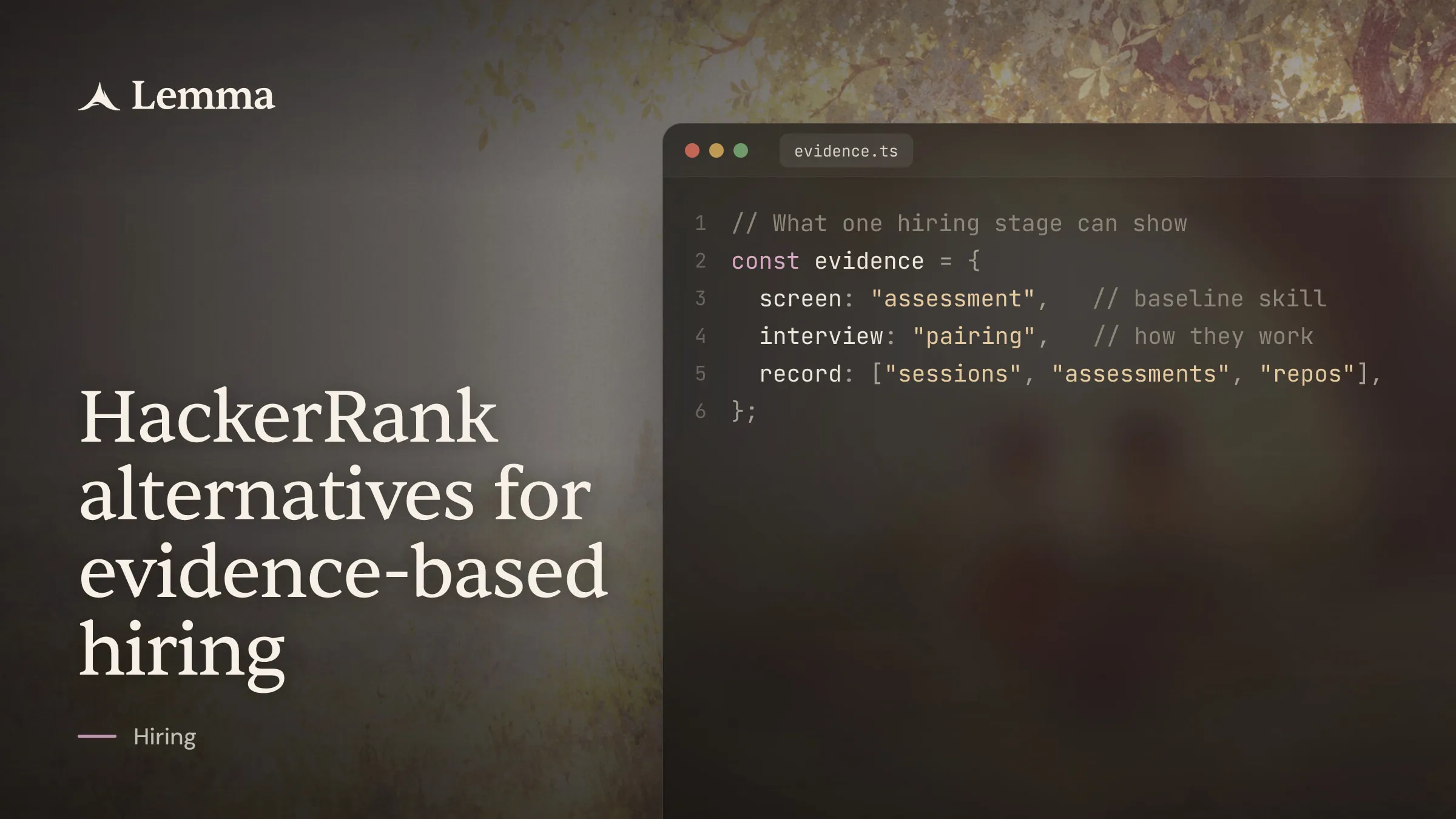
A practical rule is “one claim, one proof”. If you claim window functions and cohorts, link to a commit that contains them. If you claim broad competence, link to an assessment outcome. If you claim you can debug and explain, link to a live session record.
If you want to understand how evidence types fit together in one record, /methodology#evidence-types is the clearest overview. If your question is “what gets counted and why”, /methodology#how-evidence-is-weighed explains the mechanism.
If you use Lemma, the Skills Passport organises evidence per skill, including SQL. A reviewer can open the SQL skill and see which sessions, assessments, and connected proofs support it, with dates. The Passport view is shareable as a link, so you can keep your CV short and put depth behind one destination page. See how the Passport works at /product/passport.
What evidence is strongest for SQL, and what are the common pitfalls?
Strong evidence is evidence a reviewer can inspect, or evidence recorded under constraints. Pitfalls usually come from proof that is hard to read, not clearly yours, or not tied to the specific SQL skill you claimed.
Repository or commit proof (what to include)
A repository is most useful when it shows your SQL in context. That might be a small analytics project, a set of transformations, or even one well-scoped query file with explanation.
What to include:
- A deep link to the relevant file or commit.
- A short README section explaining assumptions.
- One or two comments explaining non-obvious joins or filters.
On Lemma, an external proof can be a GitHub repository or commit linked through your own account, so ownership is checked against that platform. Two external proofs per skill count, which pushes you to pick your best examples rather than flooding a reviewer.
Assessment proof (what it shows)
Assessments are good when the hiring team wants a standard signal quickly, or when your work is hard to share. They are most useful when you treat them as one input, not as the whole story.
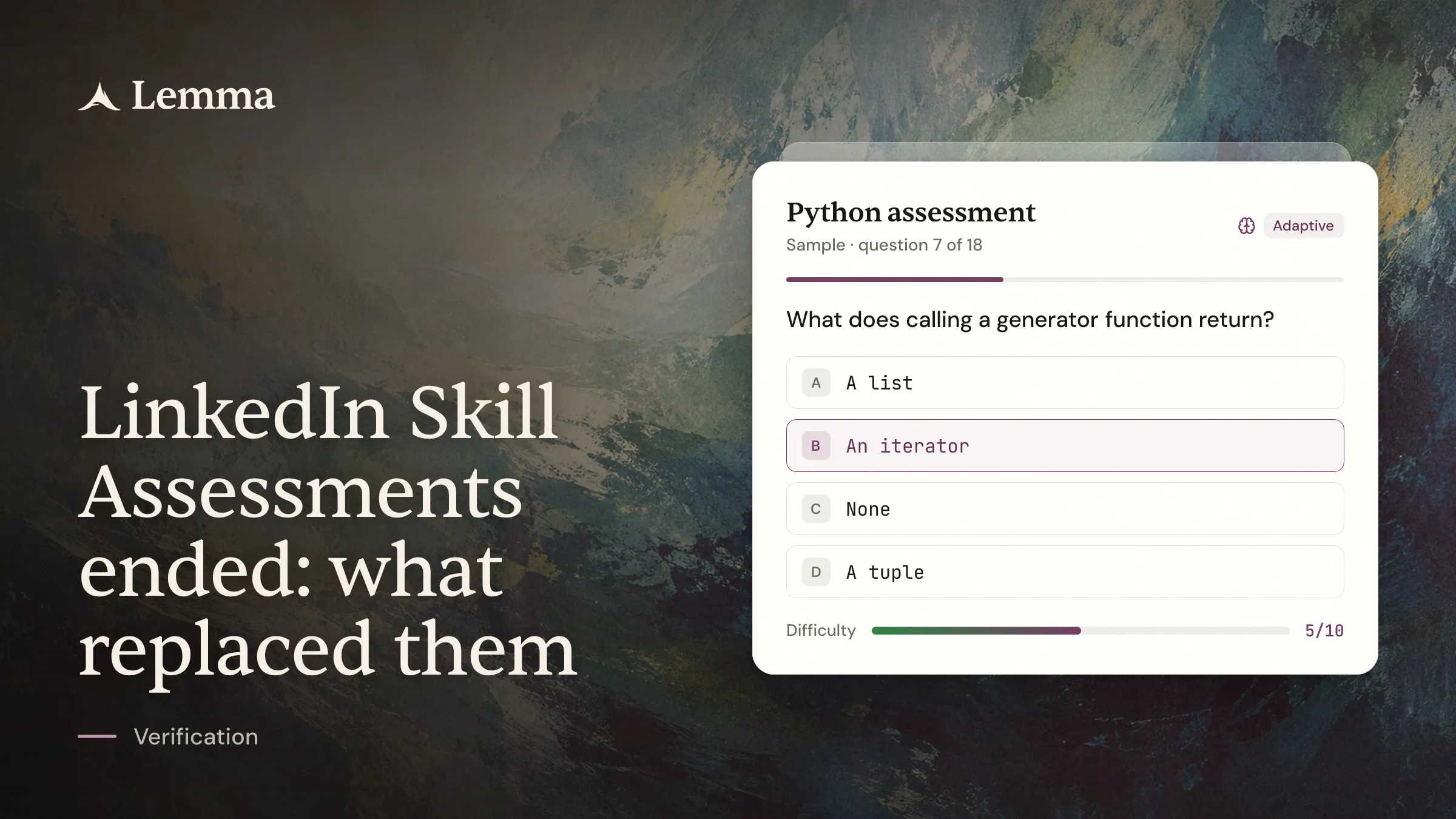
On Lemma, adaptive assessments run on a 1 to 10 difficulty scale and ask between 15 and 25 questions, stopping once your level holds steady. Each question has a time limit and you cannot change an answer afterwards. A pass is 6.5 out of 10. If you want the detail, /product/assessments describes the format.
Live session evidence (what it reveals)
Live evidence is useful for answering “can you reason about SQL out loud?” That matters when the job includes debugging ambiguous issues with others.
A good SQL-focused session tends to show:
- How you clarify the question and define grain.
- How you sanity-check joins and filters.
- How you explain trade-offs and edge cases.
Lemma’s sessions are live video sessions booked against one skill, which helps keep the evidence interpretable later. If you want the mechanics, /product/sessions covers how sessions are recorded.
How do you present SQL evidence on a CV without cluttering it?
Use a small number of links, placed where they answer the biggest doubts. A CV still needs to scan well as plain text. Evidence should add depth without making the page noisy.
A clean pattern is:
- Skills section: one “SQL (evidence)” link.
- Experience bullets: one repo/commit link for your best SQL artefact.
- Projects section (optional): one link for a standalone SQL project.
If you use Lemma, you can share a link to the whole Passport or to selected skills only; hidden skills stay hidden. Each shared skill keeps its evidence and dates. Pro and Ultra add PDF export and a custom Passport URL, while sharing links is available on every plan. The Passport document is signed, so a reader can confirm Lemma issued it and that it has not changed since.
If you do not use a Passport, you can still use the same idea. Create a small “SQL evidence pack” and link to it once.
| Item | Best for | What to pick |
|---|---|---|
| 1 repo/commit | Showing real queries and structure | Your clearest, best-scoped SQL |
| 1 assessment result | Showing breadth under time limits | A recent result you can discuss |
| 1 session record | Showing reasoning and communication | A session focused on modelling or debugging |
If you want more hiring-focused guidance on what interviewers look for, /blog/assess-technical-skills-assessments-in-interview is not a page that exists. Instead, use /blog/assess-technical-skills-in-interview for a practical view of what gets assessed, and why.
How should you handle SQL skills if your work is proprietary?
Use proof that does not expose sensitive data: a public repo with synthetic data, an assessment result, or a live session where you talk through a problem without sharing company tables. You can still be specific about patterns and constraints, even when raw data is private.
If you build a public repo, keep it honest. State what is synthetic, and what reflects real constraints. Prefer small, readable examples over large, opaque ones.
If you rely on assessments and sessions, translate private work into general mechanisms. For example: “Definitions changed over time, so I wrote validation queries for each transformation step.” That communicates competence without naming internal tables.
If you want the reviewer to see only SQL, share only SQL evidence. A single destination link, whether it is a curated page you host or a skill view in a Passport, reduces clutter and keeps screening focused.
 ChatGPT
 Claude
 Perplexity