Resume skills examples only help if a reader can trust them. A skill on a CV is a claim until you attach something checkable behind it, like a repo, an assessment result, or a live session record. This guide gives tech-focused skill examples, each paired with proof a reviewer can inspect.
What makes a resume skill credible (rather than just a claim)?
A resume skill is credible when it is specific, scoped, and backed by evidence someone else can check. That evidence is usually work you own (repo, deployment, design file), a timed assessment result, or a recorded interaction with another practitioner.
The mechanism is straightforward. A hiring manager is making a risk call with limited time. Evidence reduces ambiguity because it shows what you did, when you did it, and what constraints you worked under.
A useful mental model is: Skill → behaviour → artefact → verification. “React” is vague. “Built a React form flow with validation and tests” is a behaviour. A GitHub repo or deployment is an artefact. A reviewer opening it is verification.
Use this checklist each time you add a skill.
| Check | What good looks like | What to avoid |
|---|---|---|
| Scope | One skill, one context (e.g., “SQL: window functions”) | Broad claims (“expert in databases”) |
| Recency | Evidence has dates, or a visible history | Only old coursework or undated claims |
| Ownership | Link is tied to your account | Screenshots or copied snippets with no history |
| Observability | Someone can inspect output, tests, or reasoning | Private work with no shareable artefact |
| Consistency | Skill appears across CV and project bullets | A buzzword list with no follow-through |
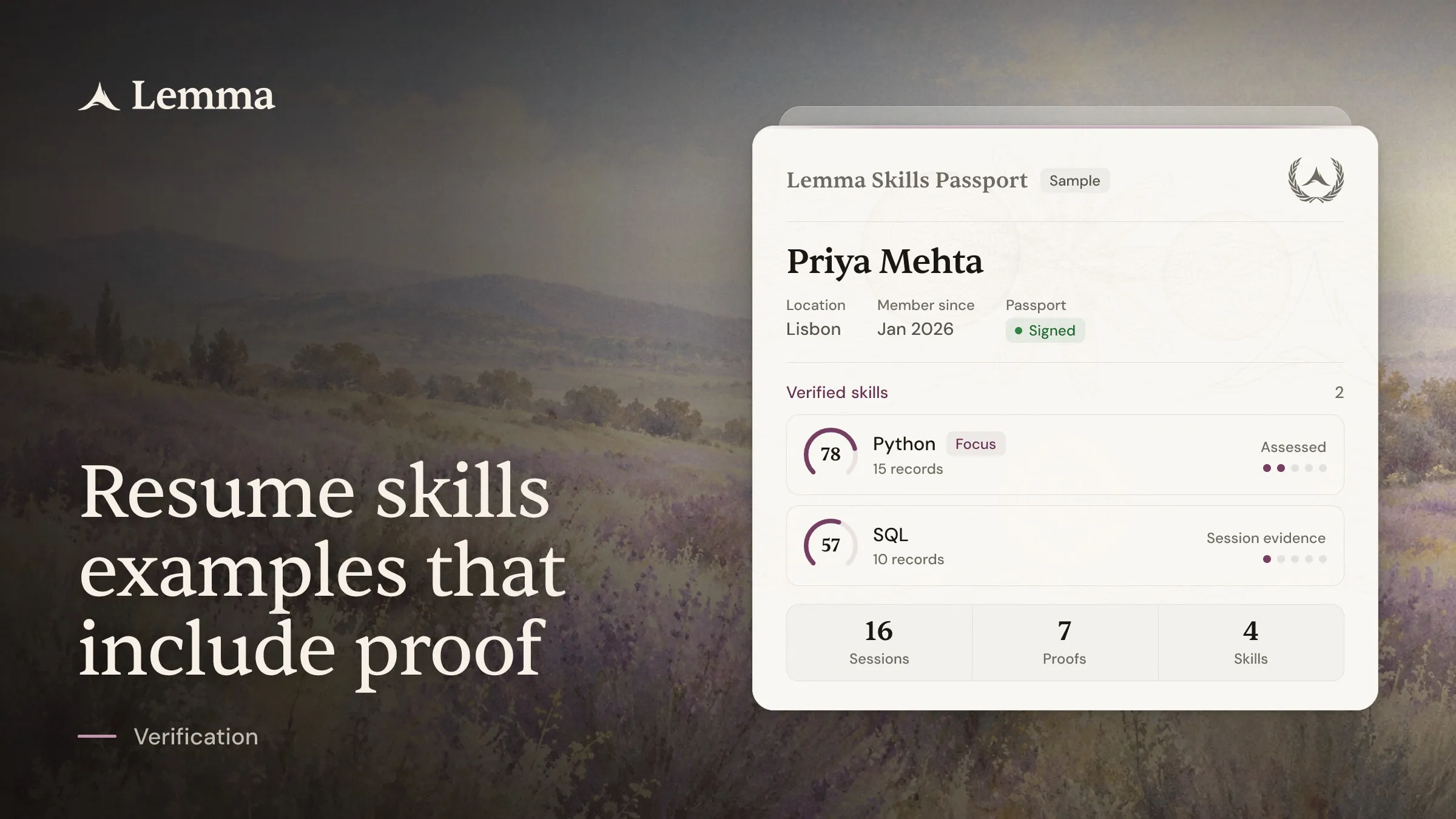
Lemma’s approach follows the same logic. A Skills Passport organises evidence from live sessions, adaptive assessments, AI tutor practice and connected work into skill records (/product/passport). Each skill shows an SCI score (0–100) and the drivers behind it, so a reader can trace the number back to the underlying records (/product/sci, /methodology).
Which resume skills should you list for tech roles (with proof examples)?
List skills that map to the job’s work, then pair each one with proof you can share. For many tech roles, that means a blend of language, framework, data, delivery, and collaboration skills.
The mechanism is coverage. A repo proves you can ship artefacts. An assessment proves performance under timed constraints. A live session record can show how you reason and communicate. Using more than one type makes it easier to interpret your claim fairly.
Here are resume-ready examples you can adapt.
| Skill area | Resume skill example (claim) | Evidence you can attach (proof) |
|---|---|---|
| JavaScript/TypeScript | TypeScript: typed API clients and domain models | Repo with commit history; timed assessment result |
| Frontend | React: forms, state, routing, component testing | Repo plus deployed preview; session where you reviewed code (example) |
| Backend | Node.js: REST endpoints, auth, background jobs | Repo; integration tests; debugging notes (example) |
| Data | SQL: joins, window functions, analytics queries | Assessment result; repo with SQL scripts |
| System design | System design: caching, queues, failure modes | Design notes (example); session focused on one prompt (example) |
| DevOps | Docker: local dev environments and CI basics | Repo with Dockerfile and pipeline config |
| Cloud | AWS: IAM basics, storage, serverless patterns | IaC repo or configuration; assessment result |
| Product/design | Figma: components, variants, handover | Figma file linked from your account; critique notes (example) |
If you want a deeper SQL-specific walk-through, the SQL guide goes skill-by-skill and stays focused on proof (/blog/how-to-show-sql-skills-on-resume).
How do you write a skills section that points to proof?
Write your skills section as verifiable pointers, not a list of nouns. Keep the label tight, add a short scope, then reference where the proof sits (projects, portfolio, or a single evidence hub).
The mechanism is reducing friction. Reviewers skim. If they can see “what you mean” and “where to check it” in one glance, your skills section stops being decorative and starts being useful.
A practical format looks like this:
- React (testing) — component and integration tests for forms. (Proof: Project A repo; deployed preview)
- SQL (analytics) — window functions, CTEs, data checks. (Proof: SQL assessment; query repo)
- System design — scaling reads, caching trade-offs. (Proof: design notes; session record)
Two rules keep this honest.
Attach at most one or two proofs per skill. It forces you to choose evidence that actually supports the claim. Lemma applies a similar constraint: only two external proofs per skill count (GitHub, Figma, Vercel), linked through your own account so ownership is checked against that platform (/methodology#evidence-types).
Keep proof close to the skill. If the skills list is on page one and the proof is buried elsewhere, most readers will never connect them.
If you do use a Lemma Skills Passport, you can point to a single link where each published skill keeps its evidence and dates (/product/passport). You can share the whole Passport or only selected skills, while hidden skills stay hidden.
What proof works best for common tech skills (and what each proves)?
Different proof types answer different doubts. Repos and deployments show outputs. Timed assessments show performance under constraints. Session records can show interaction and reasoning.
The mechanism is triangulation. When two independent signals point to the same capability, it becomes easier to trust your summary line. For example, an assessment can show breadth in TypeScript, while a repo shows you used it in a codebase with tests.
Use this table to pick evidence that matches the claim.
| Proof type | What it is good for | What it misses | When to use it |
|---|---|---|---|
| GitHub repo/commit | Ownership, history, code quality signals | Live reasoning, collaboration context | You can share the work openly |
| Vercel deployment | Working UI and user flows | Architecture detail, test depth | Frontend roles; showing shipped behaviour |
| Figma file | Components, variants, design decisions | Runtime trade-offs, implementation | Product/UI roles; design systems |
| Timed adaptive assessment | Comparable signal, breadth, constraints | Real-world context, teamwork | You need a fast way to show level |
| Live session record | Communication, debugging, trade-offs | Hard to summarise without a record | You want observed work, not just artefacts |
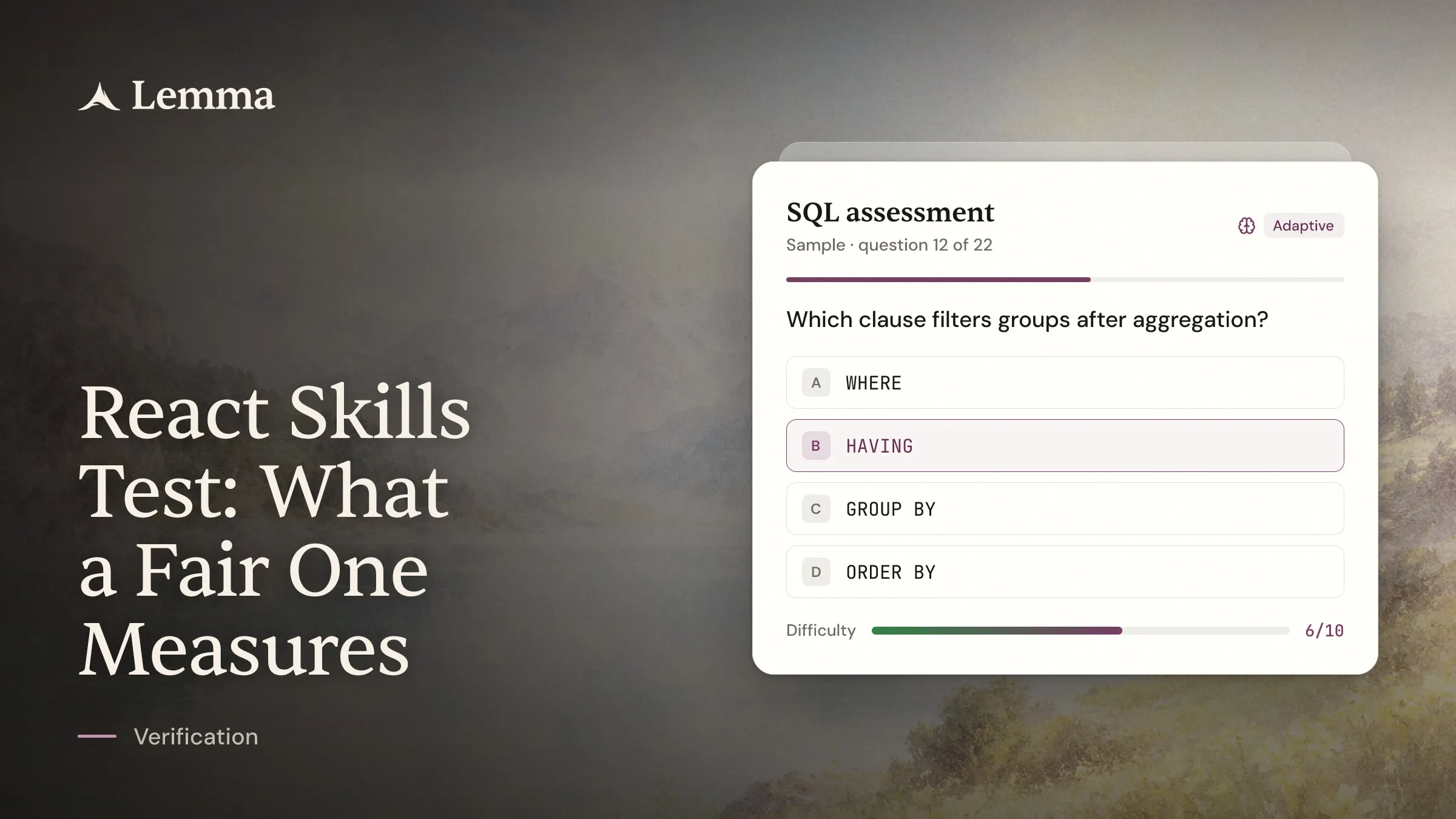
On Lemma, adaptive assessments run on a 1–10 difficulty scale, ask between 15 and 25 questions, and stop once your level holds steady. Each question is timed and you cannot change answers afterwards (/product/assessments). Those constraints matter because they make the result easier to interpret.
Lemma also keeps AI tutor practice in proportion. Passed exercises count as practice evidence, but they can add at most 5 of the 25 practice points, so software practice cannot outweigh evidence from people and assessments (/product/ai-tutor). On a CV, the equivalent is not letting “practice” (courses, drills) crowd out proofs of performance.
How can a Lemma passport link turn your skills section into proof?
A Lemma Skills Passport link lets a reader open a skill and see the evidence and dates behind it, rather than trusting your phrasing. You can share a link to the whole Passport or to selected skills only (/product/passport).
The mechanism is traceability. Lemma records five kinds of evidence: live sessions, adaptive assessments, peer confirmations, external proofs (GitHub, Figma, Vercel) and AI tutor practice. Listing a skill adds nothing to its score; only recorded evidence does (/methodology#evidence-types).
A few details are worth knowing if you expect someone to rely on the record.
- The Passport document is signed, so a reader can confirm Lemma issued it and that it has not changed since (/product/passport).
- Evidence is append-only. Corrections, revocations and disputes are added as new events rather than erased (/methodology#corrections-and-disputes).
- Every SCI score shows what drove it: which sessions, assessments, confirmations and connected proofs added points, and when (/methodology, /blog/how-sci-works).
Used well, that changes how your skills section reads. It stops being a promise that a recruiter must trust, and becomes a pointer to a checkable record.
How do you avoid “proof theatre” when adding evidence to skills?
Avoid proof theatre by matching evidence to the claim, keeping it reviewable, and being honest about limits. The goal is not to collect badges. It is to reduce uncertainty about what you can do.
The mechanism is selecting evidence with clear context. A repo with history is often more informative than a generic credential, but credentials can still help when you need a standardised signal. If you are weighing certifications, there is a separate discussion focused on that trade-off (/blog/are-certifications-worth-it-software-engineers).
Use this quick check before you add any proof link.
| Question | If the answer is “no” | What to do instead |
|---|---|---|
| Can the reader open it quickly? | It will not be reviewed | Use one stable link and one artefact |
| Does it show your contribution? | It may look like borrowed work | Link a commit/PR, or explain your slice |
| Does it match the scope of the claim? | It reads like padding | Narrow the claim or replace the proof |
| Is there a date or history? | Recency is unclear | Prefer artefacts with timestamps/logs |
| Would you defend it in interview? | It increases risk | Remove it or rewrite it honestly |
When you treat skills as claims that need evidence, the outcome is calmer interviews. You and the reviewer start from shared facts, not from a buzzword list.
 ChatGPT
 Claude
 Perplexity