Yes, but most skill swap apps stop at the match. They introduce two people who can teach each other and leave the rest to chance. A skill swap app that proves what you learned does more: it records each session against one skill, ties it to a rating from your partner, and keeps a dated record you can show someone else.
That difference decides whether a year of swapping leaves you with a skill and nothing to show for it, or a skill and the evidence behind it.
What is a skill swap?
A skill swap is an exchange where two people teach each other what they know. You teach Python for an hour; someone teaches you product design. No money changes hands in the simplest version, only time and attention.
It works because explaining something is one of the best ways to understand it, and because practitioners know things courses do not cover. The research behind that is in peer learning vs online courses; this post is about the apps.
Why do most skill swaps fizzle out?
The idea is simple. The practice is fragile, and the same few problems come up again and again.
- The double match is rare. You need someone who teaches what you want and wants what you teach, at a time that suits you both.
- Nobody turns up. With nothing at stake, a session is easy to skip, and one missed session often ends the swap.
- The exchange feels uneven. One person keeps teaching; the other keeps learning; resentment follows.
- Nothing is left behind. Even when it works, the learning lives only in your head. You cannot show anyone that six sessions on SQL happened, let alone how they went.
A good app is mostly a set of answers to those four problems.
What should a skill swap app do to prove what you learned?
Look for features that answer each problem, and check how they are enforced rather than how they are described.
| Problem | What to look for | How Lemma handles it |
|---|---|---|
| Finding a partner | Matching that explains why each suggestion was made | Suggestions list their reasons: mutual skill fit, focus skill, shared language, timezone, track record |
| Uneven exchange | A way to trade time without a perfect two-way match | Teaching earns credits; learning spends them. Credits are held at booking and charged only when the session completes |
| No-shows | Clear, automatic consequences | Join within 15 minutes or it counts as a no-show; your held credits come back in full if your partner never arrives |
| Late cancellations | A defined cut-off | Cancelling under 24 hours before the start counts as late and affects reliability |
| Nothing to show | Each session recorded against one skill, with a rating | Sessions complete from attendance and are added to both people's records with the rating each gave |
| Mistakes | A way to correct a wrong record | Either person can report a problem; a person reviews it and the correction is logged, not erased |
Most of these are covered in more detail on the sessions page, and the matching signals are set out in the methodology.
How does a session become evidence?
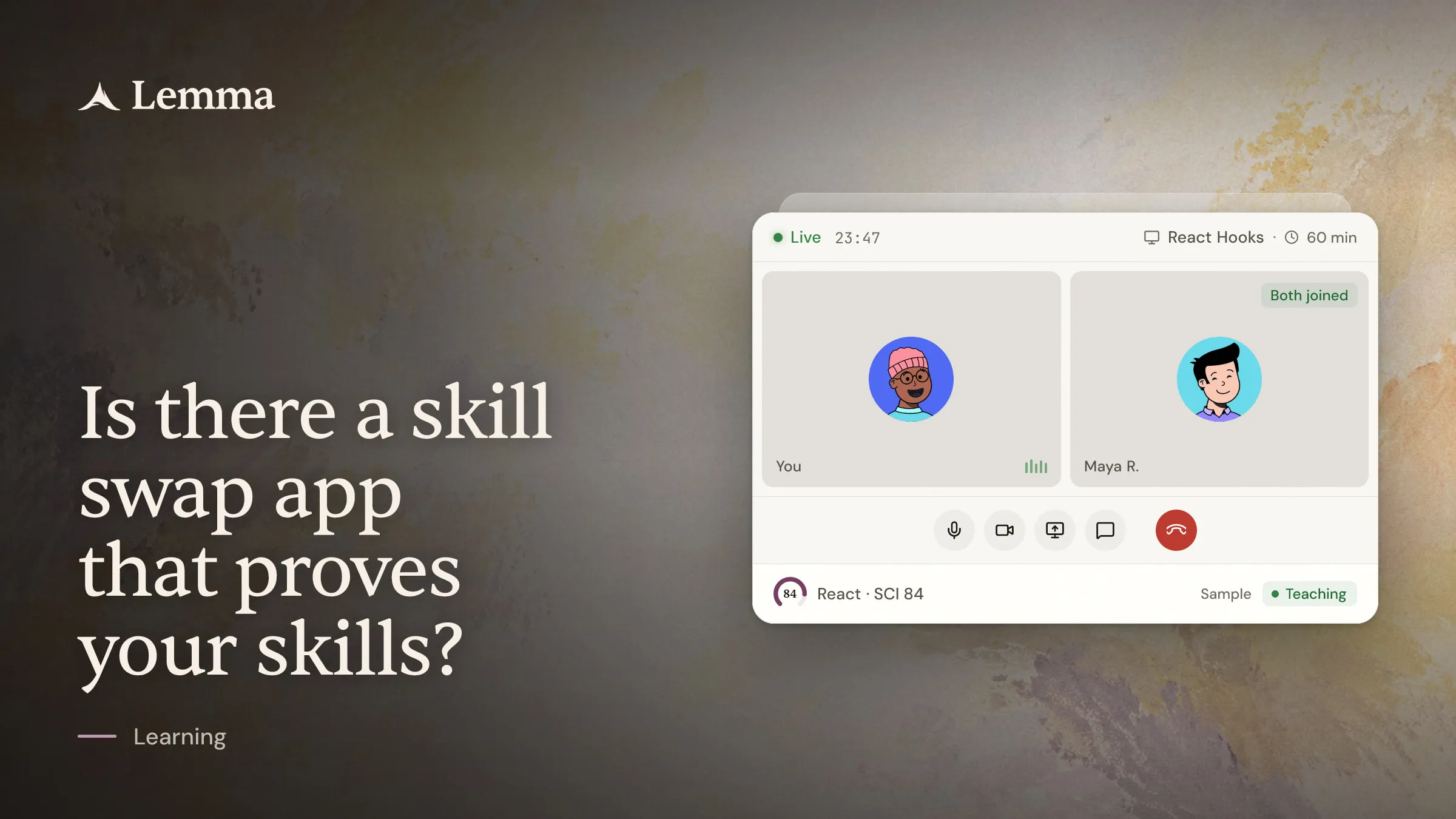
On Lemma, every session is booked against one skill from the catalogue, for 30 or 60 minutes. When both people have joined, it completes on its own. You then rate each other and can add a short reflection. The session is written to the evidence log of that skill on both Skills Passports.
It feeds two parts of the SCI score for that skill:
- Practice. Each completed session adds to practice, weighted by the rating it received. A session rated one star adds nothing. Sessions where you teach count one and a half times, because teaching asks more of you. Sessions can fill 20 of practice's 25 points.
- Reliability. Completed sessions build it, up to 20 points. No-shows and late cancellations in the last 30 days take points away.
The rest of the score comes from evidence sessions cannot provide. How the SCI score works shows every component with a worked example.
Can sessions alone prove a skill?
No, and an honest app should say so. Sessions are evidence of practice and of how you work with people. They are not evidence of everything.
Practice is capped at 25 of 100 points, so a hundred sessions cannot carry a skill to a high score on their own. That is deliberate. Proof, the largest component, needs evidence that is harder to produce: an adaptive assessment, a linked repository or design file, or confirmations from a few distinct people. An integrity check also looks for patterns built to inflate a score, such as most sessions with the same partner, and can only lower the result.
The useful way to think about it: swapping is how you learn and how you show you can explain and collaborate. Assessments and linked work are how you show depth. A Passport puts them side by side, per skill.
What does a good skill swap look like in practice?
Here is an example, not a real person. Say you are a backend developer who wants to learn product design, and you can teach Python.
- You set Python as a skill you teach and product design as your focus skill.
- Matching suggests a designer who wants to learn Python. The suggestion says why: a mutual fit, your focus skill, a shared language, compatible timezones.
- You book a 60-minute session to learn design. Your credits are held. A week later, she books you for Python, and you earn credits back.
- After each session you rate each other. Your Python record shows teaching sessions; your product design record shows learning sessions.
- A few months in, you take a product design assessment and link a Figma file. Now that skill has practice and proof behind it.
The swap did not need to be perfectly even, and nothing about it relied on memory.
What are the warning signs in a skill swap app?
A few patterns suggest an app will not hold up once the novelty wears off.
- Matching with no reasons. If you cannot see why someone was suggested, you cannot judge whether the suggestion is any good.
- No rules for missed sessions. If a no-show costs nothing, expect a lot of them.
- Unlimited, free-floating endorsements. If anyone can confirm anyone's skill with a click, the confirmations will mean nothing to the people you show them to. Look for limits on how many count and checks for trading.
- Records you cannot export or share. If your history only exists inside the app, it helps you there and nowhere else.
- No way to fix mistakes. Sessions go wrong. If there is no process for reporting a problem and correcting the record, a single bad session can stick.
Is a skill swap app worth it if you already take courses?
Usually, yes, once a course stops answering your questions. Peer learning vs online courses covers the signs that you have reached that point. What an app adds on top is a record: sessions that would otherwise live only in your memory become dated evidence you can show.
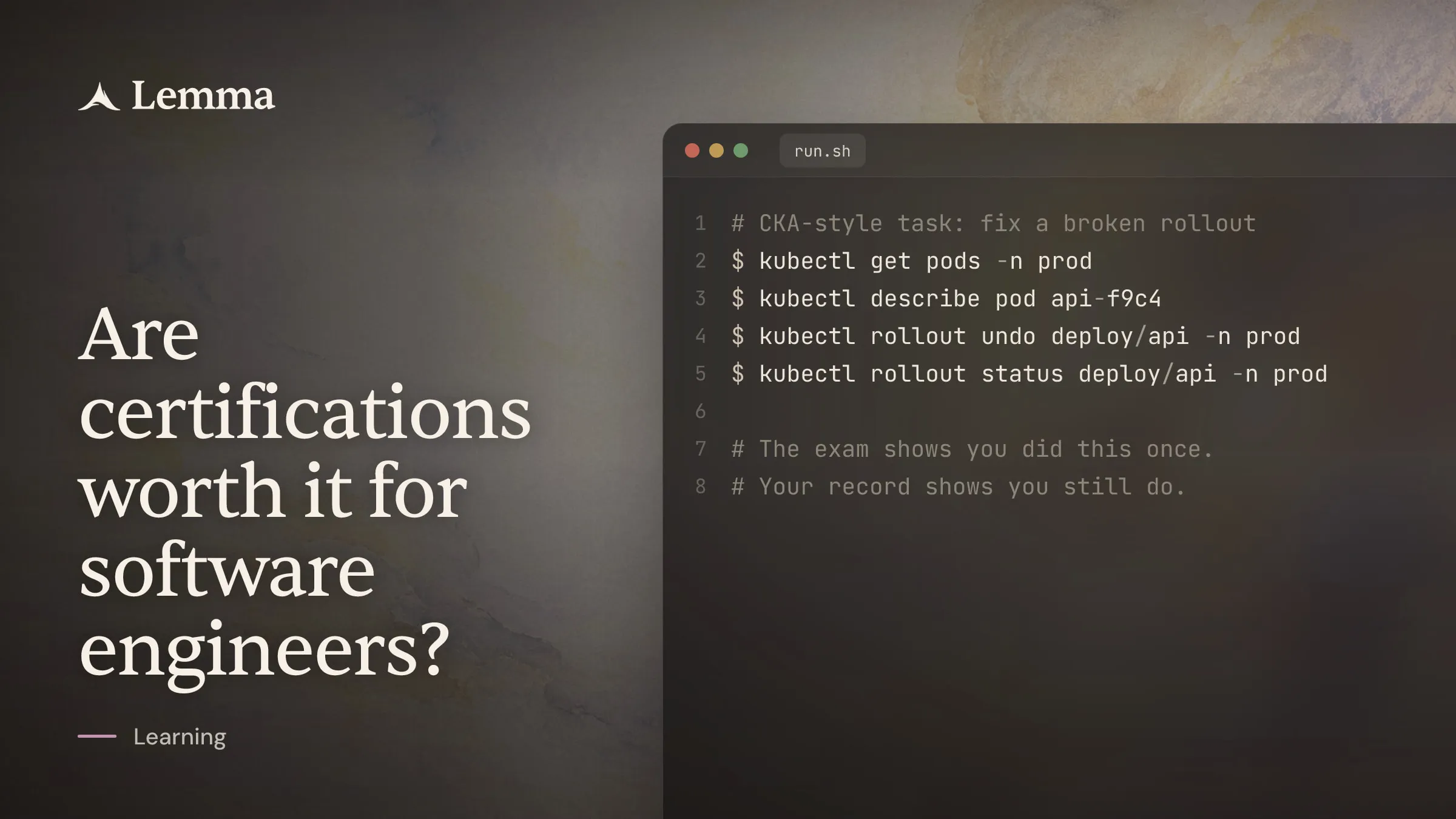
If you are deciding how much weight a certificate carries on its own, read are certifications worth it for software engineers?.
How do you get started?
Lemma is in early access. Join the list and, when your place opens, set the skills you can teach and the one you want to focus on. The first session is where the record starts.
 ChatGPT
 Claude
 Perplexity