Sometimes. A certification is worth it for a software engineer when a role, client or employer names it, when it covers the platform you work on, or when it makes you perform real tasks under exam conditions. It is rarely worth it as a general signal of ability, because hiring teams can usually get a better one from your work.
The rest of this post sets out where certifications help, where they do not, what popular ones actually test, and what to put next to one.
What does a certification actually prove?
A certification proves that you met an issuer's standard on a particular exam, on a particular date. The issuer publishes what the exam covers, sets the pass mark and stands behind the result. That makes it a clear external standard, which is genuinely useful.
What it does not prove is how you apply the skill now: the quality of your code, how you debug something unfamiliar, how you work in a team. Two engineers with the same certificate can be at very different levels. That gap is the whole question.
How do popular certifications differ?
Not all certifications test the same thing. Some are multiple choice; some make you perform tasks. Most expire. Here are three examples, with details from each issuer's own pages.
| Certification | How it tests | How long it lasts |
|---|---|---|
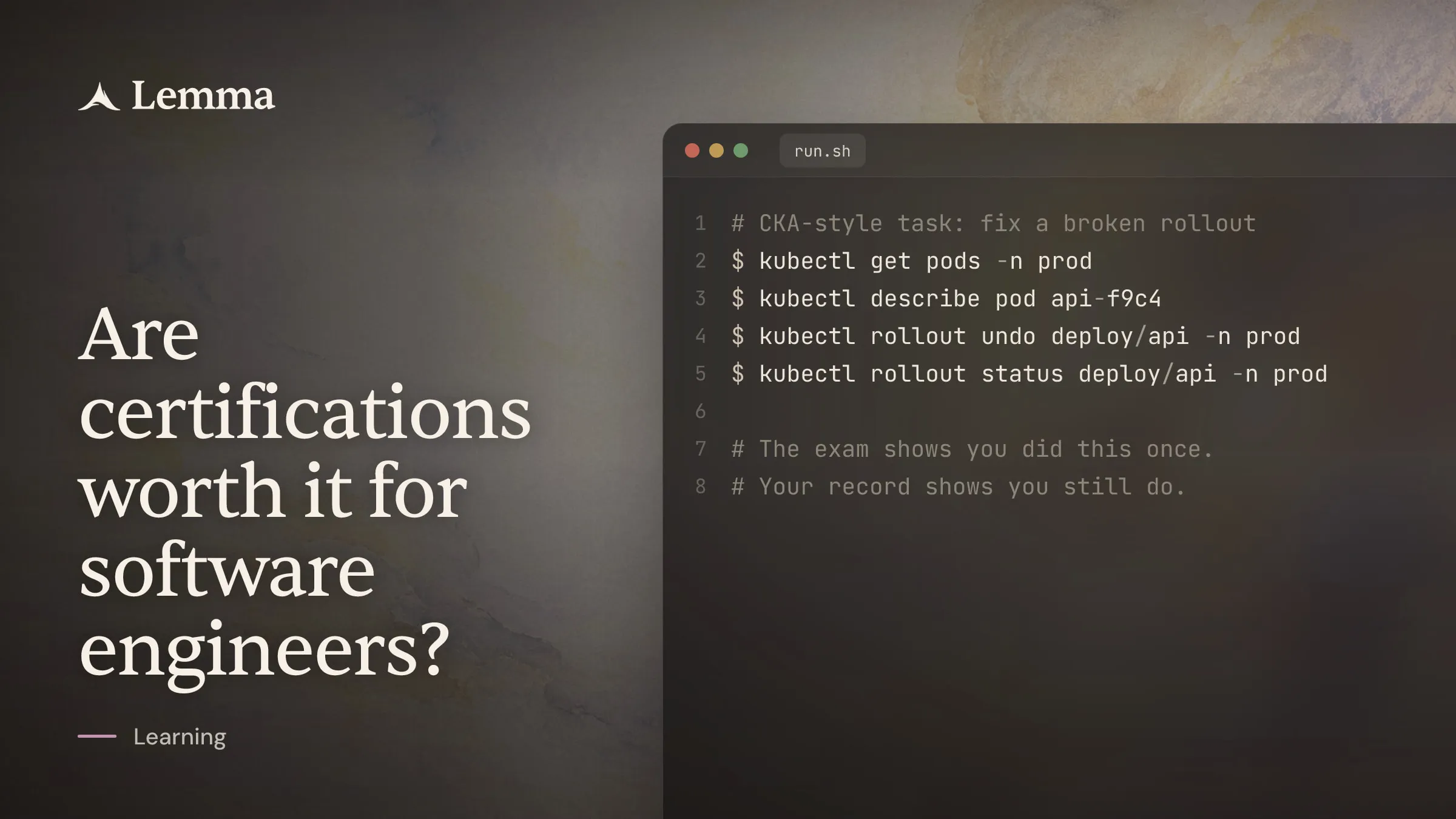
| Linux Foundation CKA (Kubernetes administrator) | An online, proctored, performance-based exam: you solve tasks from a Kubernetes command line in 2 hours | Valid for 2 years; one retake included |
| AWS certifications | Exams per role and level | Renewing adds 3 years of validity; a maintain option adds 1 year through AWS Skill Builder |
| Microsoft role-based and specialty certifications | Exams per role | Renewed each year by passing a free, unproctored, open-book online assessment; Fundamentals do not expire |
Sources: the Linux Foundation's CKA page, AWS's recertification page and Microsoft's certification renewal page.
Two things stand out. First, a performance-based exam like the CKA is much closer to evidence of skill than a recall test, because you have to do the work. Second, expiry is the norm. Issuers know that a result from three years ago says little about today.
When is a certification worth it?
When the people deciding about you ask for it, or when the exam itself makes you better.
- A role, client or tender names it. Some employers, consultancies and public-sector buyers list specific certifications as requirements. If it is a requirement, it is worth it.
- You work on a vendor's platform. For a cloud, data platform or infrastructure role, the vendor's own certification is a shared language with the hiring team.
- You want a structured syllabus. Studying for an exam forces breadth. You cover parts of a platform you would otherwise skip.
- The exam is hands-on. Performance-based exams test whether you can do the tasks, which makes the result more meaningful to you and to anyone reading it.
- You are changing fields. With no relevant job titles, a recognised certification can get your CV past a first filter. It works best with work to back it up.
When is a certification not worth it?
When it is standing in for evidence you could show directly.
- You already have visible work. For an engineer with a track record, repositories and shipped products, a general certificate adds little.
- The role tests you anyway. Many software engineering processes run their own coding screens and interviews. A certificate rarely lets you skip them.
- It is mostly recall. A multiple-choice exam on a framework mostly tests whether you studied for that exam.
- It will expire before it pays off. Renewal takes time. Count it before you start.
If you are weighing a bootcamp certificate specifically, we cover that separately in are bootcamp certificates worth it?.
What do hiring teams look at instead?
Usually, evidence of the work. In a skills-based process, a hiring team describes the role as tasks and then looks for evidence that a candidate can do them: work samples, structured technical interviews, code they can read. Our skills-based hiring guide walks through that from the employer's side, and how to assess technical skills in an interview covers the interview itself.
That does not make certifications useless. It means they work best as one item in a body of evidence, not as the whole of it.
How do you get more from a certification you already have?
Turn it into evidence of work. The exam showed you met a standard; what you did with the skill since then is what a hiring team will ask about.
- Build something with it. A certified cloud engineer with a small, documented infrastructure project in a public repository has given the reader something to inspect. The certificate tells them what you studied; the project tells them what you can do.
- Write down what you learned. A short case study of a real problem you solved with the platform, with the trade-offs you weighed, reads far better in an interview than the exam code.
- Keep it near the evidence. On a CV or profile, list the certification next to the project or role where you used it, not in a separate list at the bottom.
- Track the renewal date. If a role depends on the certification, a lapsed one can cost you more than never having it.
None of this takes much time compared with the exam itself, and it changes the certificate from a line on a CV into the start of a story you can tell.
What should you show alongside a certification?
Evidence that is current, comes from doing the work, and can be checked by someone who has never met you.
| Evidence | What it adds to a certification |
|---|---|
| Linked repositories or deployments | What you built, and your part in it |
| An adaptive assessment result | Your level on a scale, not only a pass mark |
| Live sessions with other practitioners | How you explain, debug and collaborate |
| Recent activity | That the skill is current, between renewals |
A Lemma Skills Passport collects these per skill and summarises them with an SCI score from 0 to 100. One part of that score, freshness, falls as evidence ages, which does what a certification's expiry date does, but continuously. How the SCI score works walks through the rest.
A certification on its own is not one of the evidence types SCI counts today. Keep it next to your Passport where a role asks for it. We compare the two directly in Lemma vs certifications.
How should you decide?
Ask three questions before you book an exam.
- Does anyone I want to work for ask for this certification? If yes, get it.
- Will studying for it teach me something I will use? If yes, the learning may be worth it even if the certificate is not.
- Could I show the same skill more directly? If you can link work, take an adaptive assessment or point to sessions, that may be a better use of the same hours.
If two of the three answers favour the certification, it is probably worth it. If none do, put the time into evidence of the work. For skills such as AWS, Docker or system design, the skill pages show what that evidence looks like.
 ChatGPT
 Claude
 Perplexity