Skills-based hiring means judging candidates by what they can show they do, rather than by where they studied or which titles they held. The idea is simple and widely announced. Making it work is harder: it takes changes to job descriptions, screening, assessment and interviews at the same time. Skip one, and the old proxies come back in through the side door.
This guide covers what the evidence says, why many attempts stall, and a six-step process you can run on your next role.
What is skills-based hiring?
It is a hiring process where every decision rests on evidence that a candidate can do the tasks the role needs. Degrees, job titles and years of experience can still appear as context. They stop being the filter.
In practice, three things change:
- The role is written as tasks, not as a list of credentials.
- Screening looks at evidence, such as work samples, assessment results or records of real work, instead of keywords and pedigree.
- Interviews explore how someone works, rather than re-testing basics a screen already covered.
Why are employers moving towards it?
Partly because degree requirements shut out people who can do the work, and partly because they predict less than they seem to.
The shift started before the pandemic. The Burning Glass Institute and Harvard Business School found that between 2017 and 2019, 46% of middle-skill and 31% of high-skill occupations saw material reductions in degree requirements, and that most of those changes were structural rather than a short-term response to labour shortages.
Public employers followed. In March 2022, Maryland ended four-year degree requirements for thousands of state jobs, letting candidates substitute experience, training or community college. In January 2023, Pennsylvania's governor removed the requirement for about 92% of state government jobs in his first executive order.
The research on selection supports the direction. A widely cited re-analysis by Sackett, Zhang, Berry and Lievens (2022) found structured interviews and job knowledge tests among the strongest predictors of job performance, with work samples also useful. Those are all ways of observing skill directly.
Why do so many skills-based hiring efforts stall?
Because removing a requirement from a job ad is not the same as changing who gets hired.
The Burning Glass Institute and Harvard Business School tracked what happened after firms dropped degree requirements. In their 2024 report, covering 11,300 roles at large firms, the share of hires without a bachelor's degree rose by about 3.5 percentage points in roles that dropped the requirement. Across all hiring, that came to roughly 97,000 extra opportunities a year out of 77 million hires: fewer than 1 in 700.
The firms split into three groups:
- Leaders, who changed their hiring for real and increased non-degree hires in those roles by nearly 20%.
- In name only, about 45% of firms, who changed the ad but not who they hired.
- Backsliders, about one fifth, who made early gains that did not last.
The authors' diagnosis is the useful part. Companies fall back on proxies when they have no practical way to assess a candidate's skills. So the work is not in deleting a line from the job ad. It is in building the assessment that replaces it.
Step one: how do you write a role as tasks?
Ask what the person must be able to do after a month, a quarter and a year. Write each as an observable task.
"Five or more years of React" becomes "build and ship a stateful interface with clear component boundaries, and review others' work on it". The first is a proxy. The second is something you can find evidence for. Three to five tasks are usually enough. If a requirement does not map to a task, question why it is there.
Here is a before and after for a mid-level backend role:
| Before: requirements | After: tasks |
|---|---|
| BSc in Computer Science or related field | Design and ship an API endpoint end to end, with tests |
| 5+ years of backend experience | Diagnose a production issue from logs and metrics |
| Experience with microservices | Change a service safely without breaking its callers |
| Strong communication skills | Review a colleague's pull request with clear, actionable comments |
The right-hand column is longer to write and far easier to assess. Every row suggests its own evidence.
For skill-specific detail, the skill pages describe what competence looks like, for example React, SQL or product management.
Step two: how do you decide what evidence you need?
For each task, decide what would convince you, and write the bar down before you see a candidate.
| Kind of task | Good evidence | Weak evidence |
|---|---|---|
| Building or changing code | Work sample, linked repository, project-based assessment | Years of experience |
| Analysis or judgement | Case exercise, structured assessment | Degree subject |
| Collaboration and communication | Live pairing, rated sessions with other practitioners | Self-description |
| Domain knowledge | Job knowledge test, adaptive assessment | Course certificates alone |
Writing the bar first is what makes the process fair, and it is what makes a decision explainable later.
Step three: how do you screen on evidence instead of CVs?
Ask candidates for evidence, not keywords. That can be a short work sample, an assessment link, or a record they already hold.
A Skills Passport is one way to receive it: each skill comes with an SCI score and the items behind it, so you can see whether a result rests on assessments, live sessions or linked work. How the SCI score works explains the parts. If you would rather run the assessment yourself, Lemma's technical hiring tools invite candidates to an assessment and return a structured result. They are in early access, as is programmatic access through the developer API.
Whatever you use, apply the same screen to everyone, including internal candidates and referrals. Exceptions are where proxies creep back.
Step four: how do you assess the core skill?
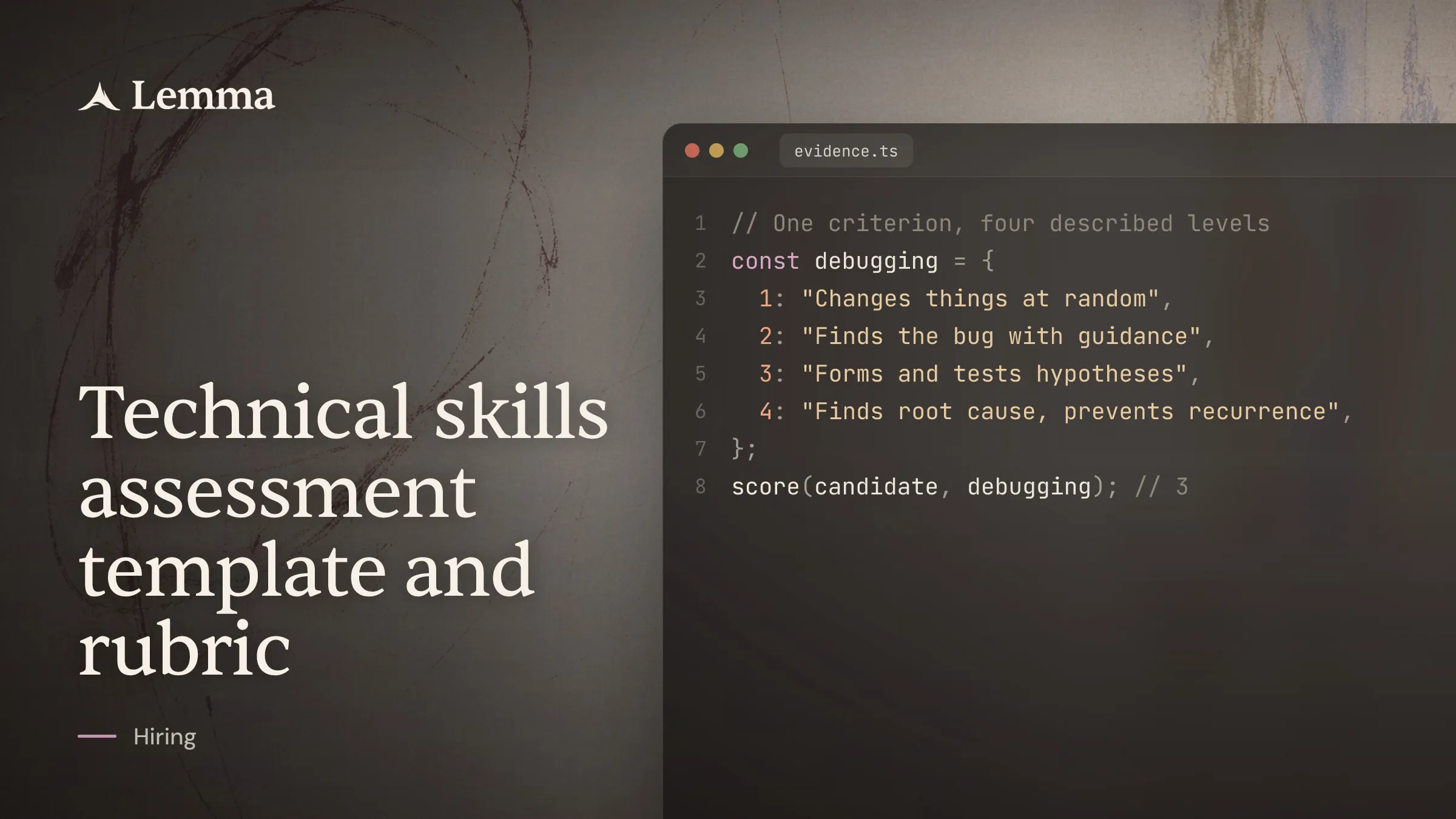
Use a format that resembles the job. For engineering roles, that usually means reviewing, debugging or extending existing code rather than solving puzzles. Our technical skills assessment template gives you a rubric with described levels and a scorecard to copy, and our comparisons with HackerRank, Codility and TestGorilla cover the main platforms.
Keep it proportionate. One focused task with a clear rubric tells you more than a long take-home, and it respects candidates' time. Cap take-homes at a few hours and pay for anything longer.
Step five: how should interviews change?
When evidence of the core skill arrives before the first conversation, interviews no longer need to re-test basics. Spend the time on how someone approaches an unfamiliar problem, how they debug, and how they explain trade-offs.
Structure still matters. Ask every candidate the same prompts and score against shared anchors. How to assess technical skills in an interview covers task design and scoring in detail.
Step six: how do you check it is working?
Measure outcomes, not announcements. Three numbers tell you most of what you need:
- Who you hire. Compare the share of hires without a degree, or from non-traditional routes, before and after the change.
- How they perform. Compare early performance reviews and retention for hires made through the new process.
- Where candidates drop out. If many strong applicants abandon a long take-home, the assessment is filtering for spare time, not skill.
If the first number does not move, you are in the "in name only" group. Look for the stage where proxies are still deciding.
How do AI tools change skills-based hiring?
They make claims cheaper and evidence more valuable. A polished CV, a tailored cover letter and even a tidy take-home can now be produced quickly with AI assistance, so documents tell you less than they did. Evidence you observe yourself, or evidence gathered over months, tells you more.
They also change what you assess. Most engineers now work with AI assistants, so the skill worth testing is often judgement: checking generated code, spotting what it got wrong and explaining the fix. Decide your rules for AI use before each stage, tell candidates, and score how they use the tools rather than pretending the tools do not exist.
What objections should you expect?
Three come up in almost every team.
"A degree shows commitment." It shows commitment to a degree. If commitment matters for the role, look for evidence of it directly: sustained practice, finished projects, a record that spans months.
"Assessments take too long." A focused 60-minute task scored with a rubric often replaces a CV screen, a phone screen and one interview round. Total time per hire usually falls.
"We will lower the bar." You raise it, because the bar becomes explicit. A written standard applied to everyone is harder to meet by luck or connections than an impression formed from a CV.
What should you watch out for?
Skills-based hiring can become as gameable as CV screening if one number replaces judgement. Swapping a degree filter for a single test score just creates a new proxy.
- Use more than one source. A test result plus a work sample beats either alone.
- Prefer recent evidence. A skill used last month says more than one used five years ago.
- Prefer published methods. If a vendor cannot explain how a score is produced, you cannot explain your decision.
- Set AI rules in advance. Decide whether candidates may use AI tools, say so, and score how they use them.
Lemma documents how SCI is computed in its methodology, including the caps that stop any one source from carrying a score.
How do you get started this quarter?
Internal moves work the same way. If you only apply skills-based hiring to external candidates, your own people keep being judged on titles and tenure. The same task descriptions and evidence bar can decide promotions and transfers, which is often where the fastest wins are.
Pick one role you hire for repeatedly. Rewrite it as tasks, write the evidence bar, and run the next round with a work sample and a structured interview. Compare the results with the previous round. One well-run role teaches you more than a company-wide announcement, and it gives you the evidence to change the next one.
 ChatGPT
 Claude
 Perplexity