Skill verification is the practice of producing evidence that someone can do what they say they can, and recording it so another person can inspect it. Not a claim. Not a badge on its own. Evidence, with its source attached, that a stranger could check without taking anyone's word for it.
That definition sounds obvious. Most of the signals used in hiring and learning every day do not meet it.
What is the difference between a claim, a credential and evidence?
They are three different things, and confusing them is where most verification goes wrong.
| Signal | Example | What it tells you |
|---|---|---|
| Claim | "TypeScript, advanced" on a CV | What the person says about themselves |
| Credential | A certificate from an exam or a programme | That an issuer's standard was met on a date |
| Evidence | A reviewed pull request, an assessment result, a rated session | What the person actually did, when, and who saw it |
A claim costs nothing to make. A credential is better, because someone else stands behind it, but it compresses months of work into one line and says little about today. Evidence is the most useful and the hardest to collect, because it has to come from doing the work.
Verification is the job of turning the third column into something portable and checkable.
Why are self-reported skills hard to trust?
Because the reader cannot check them without spending their own time. Interviews, take-home tasks and reference calls all exist to fill that gap, and they are expensive for everyone involved.
Employers have been moving away from the cheapest proxy, the degree requirement, for years. The Burning Glass Institute and Harvard Business School found that between 2017 and 2019, 46% of middle-skill and 31% of high-skill occupations saw material cuts in degree requirements. But their 2024 follow-up found the extra opportunity reached fewer than 1 in 700 hires in 2023, because many firms kept hiring as before. Removing a proxy does not help if nothing replaces it. Verification is the replacement.
Social signals do not close the gap either. An endorsement on a professional network records that someone clicked a button, not what they saw. We look at that in why LinkedIn endorsements don't work as skill evidence.
What counts as evidence of a skill?
Evidence is something that happened, left a record, and can be traced to where it came from. In practice it falls into a few kinds, each with its own strengths and blind spots:
- Work with another practitioner. A session where you solve a real problem or teach a concept, rated by the person who was there. It shows how you explain and collaborate, but it depends on who you were paired with.
- Structured assessments. Questions scored the same way for everyone, ideally adapting to your level. They are comparable across people, but they capture one sitting.
- External work. A repository, a design file or a deployed project that exists outside the verification system. It is closest to the job, but authorship can be hard to confirm.
- Confirmations from people and organisations who have seen your work. They add context, but they are easy to inflate unless volume is limited.
No single kind is enough. Combining them, and weighting each one honestly, is what turns scattered evidence into a signal.
What does verification look like in practice?
Take a frontend developer who wants to show they know React.
A claim says "React, 4 years". A credential might be a course certificate. Verified evidence looks different: a repository whose ownership is confirmed through the developer's own GitHub account, an adaptive assessment result placing them at a level, and three sessions where they explained hooks to other developers, each rated by the person they taught. A hiring manager can open each item, see its date and see who or what produced it.
Now take a hiring team. Instead of filtering CVs for "React", it asks candidates to share evidence and uses the interview to probe the skills with the least behind them. The skills-based hiring guide walks through that process.
Are there standards for verified credentials?
Yes, and they solve a related but different problem: proving a credential is genuine.
The W3C's Verifiable Credentials Data Model 2.0, a W3C Recommendation since May 2025, defines a credential "whose authorship can be cryptographically verified". 1EdTech's Open Badges 3.0 packages a single achievement as a signed credential compatible with that model, with the issuer, the criteria and optional evidence inside.
These standards answer "did this issuer really award this, and has it been changed?". They do not, on their own, answer "is the evidence behind it any good?". A signed badge for a quiz is still a quiz. Good verification needs both: a tamper-evident record, and evidence worth recording.
How do you judge a verification system?
Before relying on one, as a candidate or a hiring team, ask five questions.
- Can I see where each point came from? A result that cannot be traced to specific evidence is a black box.
- Is the method published and versioned? You should be able to read how evidence becomes a result, and which version of the rules applied.
- Is any one source capped? If unlimited endorsements or retakes can raise a result, it measures persistence, not skill.
- What happens when something is wrong? A trustworthy record keeps corrections and disputes visible rather than quietly editing history.
- Does old evidence fade? Skills change. A good system treats last month's evidence differently from evidence that is years old.
How does Lemma approach it?
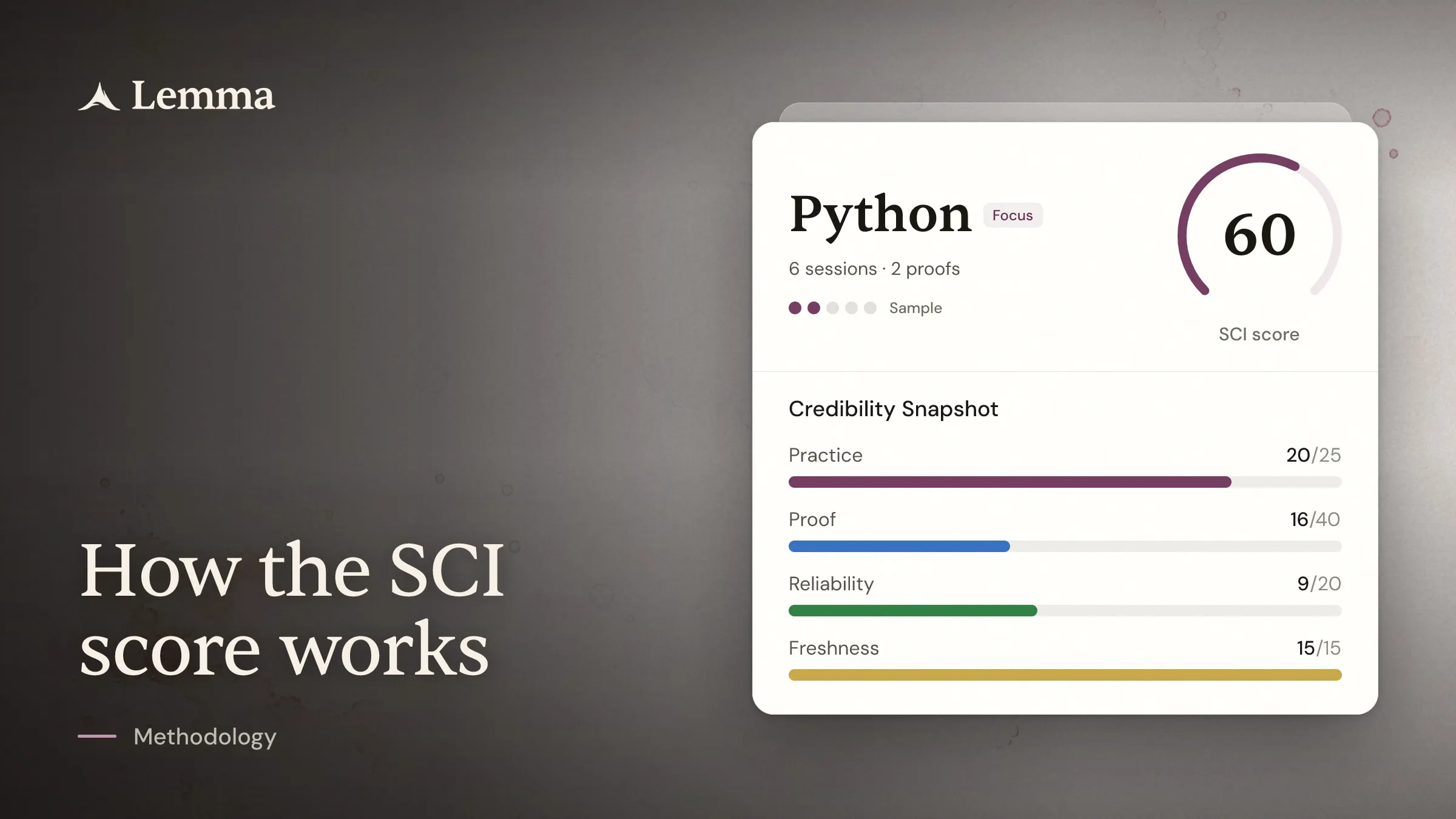
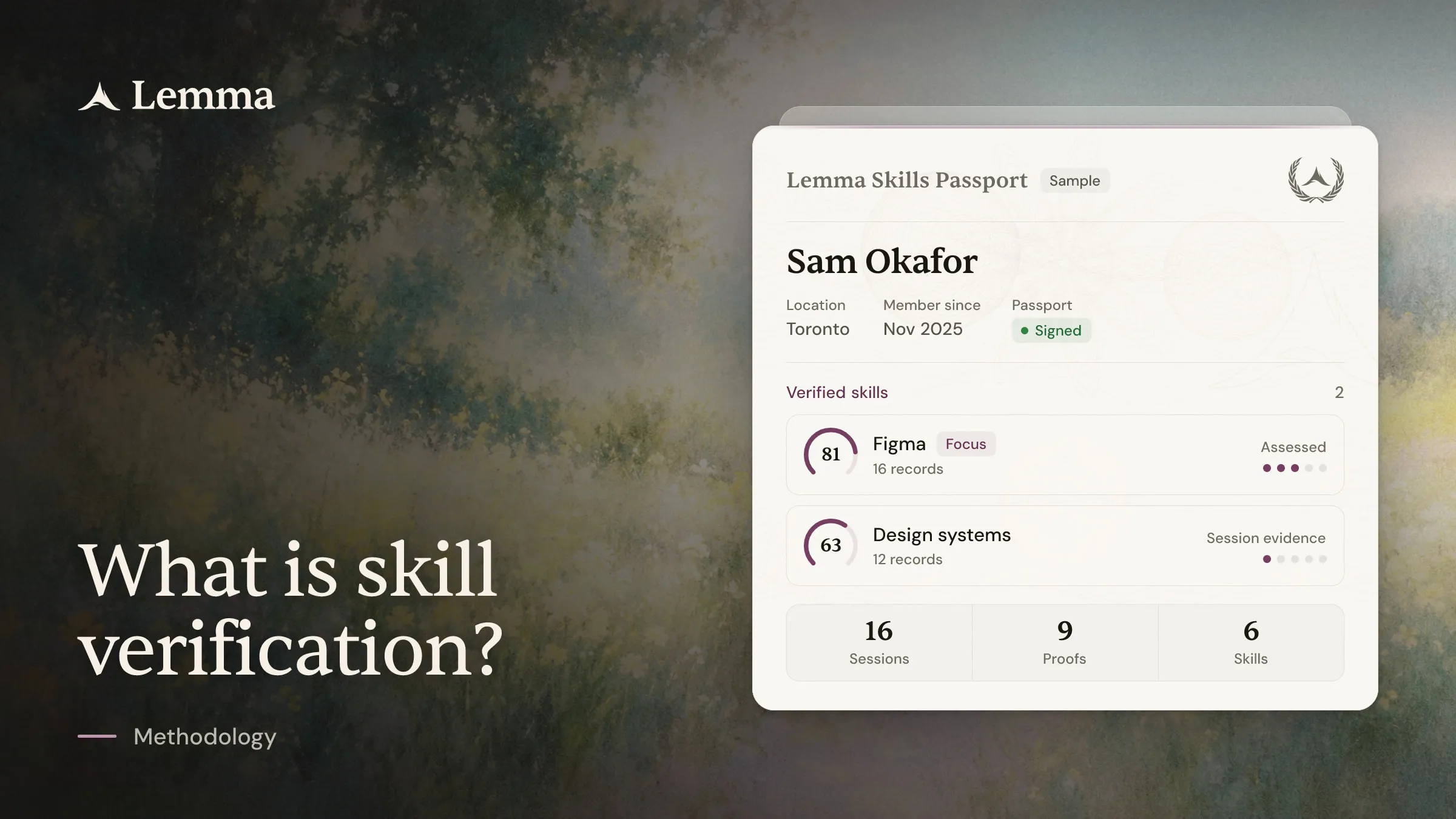
Lemma keeps evidence in one Skills Passport, one skill at a time, and summarises each skill with an SCI score from 0 to 100. How the SCI score works walks through every component with a worked example, and the methodology documents the rules.
Evidence on Lemma is append-only, and the Passport is a signed document, so anyone who receives it can check that Lemma issued it and that it has not been altered since. In the terms above, it aims to answer both questions at once: whether the record is genuine, and what the evidence underneath shows.
Why does verification matter now?
Credentials were always a proxy for skill. As more people learn outside formal programmes, change careers or work independently, the proxies describe fewer of the people who can do the work. At the same time, AI tools make polished claims cheaper to produce, so the gap between what a profile says and what someone can do keeps widening.
Verification closes that gap from both sides. If you hire, it gets you to a useful conversation sooner. If you are being hired, it is how you stop being judged by the shape of your CV.
 ChatGPT
 Claude
 Perplexity