Hard skills for a resume are specific, teachable abilities you can demonstrate, such as SQL, React, AWS, Docker, system design, or Figma. They carry more weight when a reader can check what you did, how recently you did it, and where the evidence lives. Write each skill as “skill + context + proof hook”, not as a bare keyword.
Which hard skills do tech employers actually screen for?
Most tech employers screen for hard skills that predict day-to-day output in the role. They look for evidence you can build, debug, deploy, analyse, or design, not for the longest tool list. Your job is to mirror the role’s real work, using the fewest skills that still cover it.
Start by mapping the job description into skill groups. Aim for one or two strong, provable skills per group. Screening is a quick read, so breadth without proof often looks like guessing.
Here are common hard-skill groups, with examples you can tailor.
| Skill group | Hard skills that often appear | What the reader expects you can do |
|---|---|---|
| Core language | JavaScript, TypeScript, Python, Go, Rust | Read and write code, debug, test, review |
| Front-end | React, Next.js, Vue, Angular | Build UI, manage state, handle performance basics |
| Back-end | Node.js, GraphQL, APIs | Design endpoints, handle auth, manage errors |
| Data | SQL, data analysis, data engineering | Query design, modelling, pipeline basics |
| Cloud & infra | AWS, Docker, DevOps | Deploy, troubleshoot, reason about environments |
| Product & design | Figma, UI/UX design, product management | Turn requirements into flows, prototypes, decisions |
When you need a concrete definition of one skill, use a skill page as your reference point. For example, the /skills/sql page helps you keep “SQL” specific rather than vague.
For a hiring-side view of what teams try to measure, /blog/skills-based-hiring-guide adds useful context.
How do you choose the right hard skills to put on your resume?
Choose hard skills that are relevant to the role and easy for a stranger to verify. The fastest way to lose trust is to list skills you cannot defend under questioning. The fastest way to gain trust is to list fewer skills, each with a clear proof trail.
Work backwards from the role’s core tasks. If the role is “build internal tools with React and SQL”, then React, TypeScript, SQL, and data modelling are more credible than a scattered list of frameworks.
Use this checklist to decide whether a hard skill deserves space.
| Check | What “yes” looks like | What to do if “no” |
|---|---|---|
| It is used in the target role | It appears in the responsibilities and must-haves | Keep it for a different CV version |
| You have recent evidence | You used it recently in work, study, or practice | Create a small, checkable proof |
| You can explain it live | You can talk through trade-offs and mistakes | Practise with timed questions or a mock |
| It is specific | It names a tool and what you do with it | Narrow the wording to a capability |
| It is not a duplicate | It adds meaning beyond another listed skill | Keep the one the role cares about more |
If you want examples of skill lines that already include proof hooks, /blog/resume-skills-examples-with-proof is a good companion.
How should you phrase hard skills on a resume so they sound credible?
Phrase each hard skill as a claim the reader can check. That means naming the skill, stating the scope, and adding a proof hook the reader can open. It works because you turn a keyword into a testable statement.
A simple format is:
- Skill (what you used)
- Context (where)
- Action (what you did)
- Proof hook (where to verify)
Examples you can adapt:
| Weak skills line | Stronger skills line | Why it reads better |
|---|---|---|
| SQL | SQL (Postgres): wrote reporting queries; proof in project README | Names scope and a checkable artefact |
| AWS | AWS: deployed an app and set alerts; proof in deployment notes | Describes a real task, not a label |
| React | React + TypeScript: built reusable forms; proof in component repo | Anchors the claim to work you can show |
| Docker | Docker: containerised a Node API; proof in Dockerfile + docs | Shows practical use rather than familiarity |
Two small rules keep the section believable.
First, avoid self-scored adjectives like “expert” unless you define how it was measured. Second, avoid buzzword chains. A line of tools without context gives the reader nothing to verify.
If SQL is a priority for the roles you want, /blog/how-to-show-sql-skills-on-resume goes deeper on what to show and how to show it.
What counts as proof of a hard skill, and what does each type prove?
Proof is anything that did not come only from your self-description. That includes work someone can inspect, a timed assessment result, or an evaluation of you performing the skill. Each type proves different things, so combining two is often stronger than relying on one.
A portfolio can show quality, but not always authorship. An assessment can show competence under time pressure, but not always how you work in a messy codebase. The best mix depends on what you lack.

One skill, five signals · React
Endorsements
24
Connections vouched for React
Certificate
Passed
Front-end exam · expires 2028
Coding screen
84/100
One company, one role
Test scorecard
72%
Timed test · ranked 3 of 41
React
Skills Passport · Maya R.
SCI
- +7.5
Taught: component testing with Ruben P.
60 min · rated 5 stars · 8 Oct
- +4.0
Peer confirmation from Ruben P.
After a session together · 8 Oct
- +8.0
Skill assessment passed · level 7.4
21 questions · integrity clear · 24 Sep
Here is a practical comparison you can use.
| Signal | What it is good for | What it does not prove well |
|---|---|---|
| CV skill list | Fast scanning and keyword matching | Level, recency, or independent confirmation |
| Portfolio / repo | Concrete work and depth in one area | Who did what, and how current it is |
| Certificate | Structured learning completion | Applying the skill in unfamiliar situations |
| Timed assessment | Performance under constraints | Collaboration and longer-term delivery |
| Live evaluated session | Reasoning and communication in real time | Maintenance work over months |
If you want a dedicated explanation of what “verification” means and why it matters, /blog/what-is-skill-verification covers the underlying idea.
How can you attach checkable proof without bloating your resume?
Attach proof by creating one clean “proof path” per priority skill, then reusing it across your CV and applications. This works because the reader only needs one or two clicks to confirm your claim. Once they trust one claim, the rest reads differently.
Use a two-layer approach:
- Resume layer: short skill claim plus one link.
- Proof layer: a page that shows evidence clearly, with dates where possible.
A common proof layer is a project page or README. Another option is a structured skills record that bundles different evidence types together.
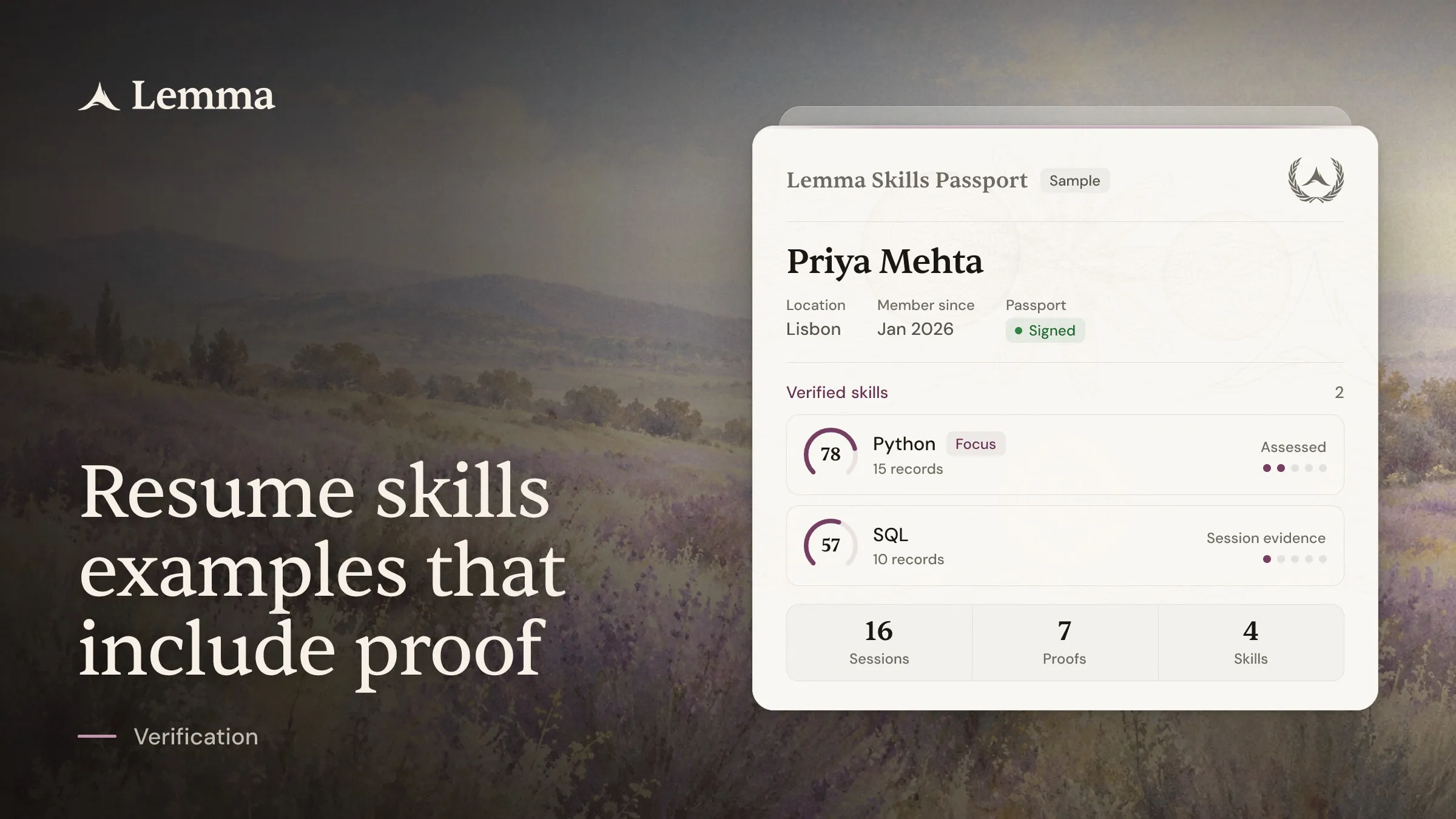
Lemma is one way to package evidence into one place. Lemma turns evidence from live sessions, adaptive assessments, AI tutor practice and connected work (GitHub, Figma, Vercel) into skill records, organised in one Skills Passport per person. A Passport link can be shared to the whole Passport or to selected skills, and hidden skills stay hidden. The Passport document is signed, so a reader can confirm Lemma issued it and that it has not changed since.

TypeScript
Skills Passport · Priya K.
SCI
- +5.0
Learned: type-safe APIs with Marek M.
60 min · rated 5 stars · 10 Oct
- +10.0
Skill assessment passed · level 7.6
20 questions · integrity clear · 1 Oct
- +7.5
Taught: generics with Ivo T.
30 min · rated 5 stars · 19 Sep
You can read how Passport sharing works at /product/passport. If you are viewing it from a hiring perspective, /solutions/technical-hiring explains how evidence-led review fits into a hiring flow.
How do you show hard skills with assessments and live sessions?
Assessments and live sessions help because they show performance under constraint, not just a polished end result. They are most useful when you lack public work, or when you need a comparable signal for a specific skill.
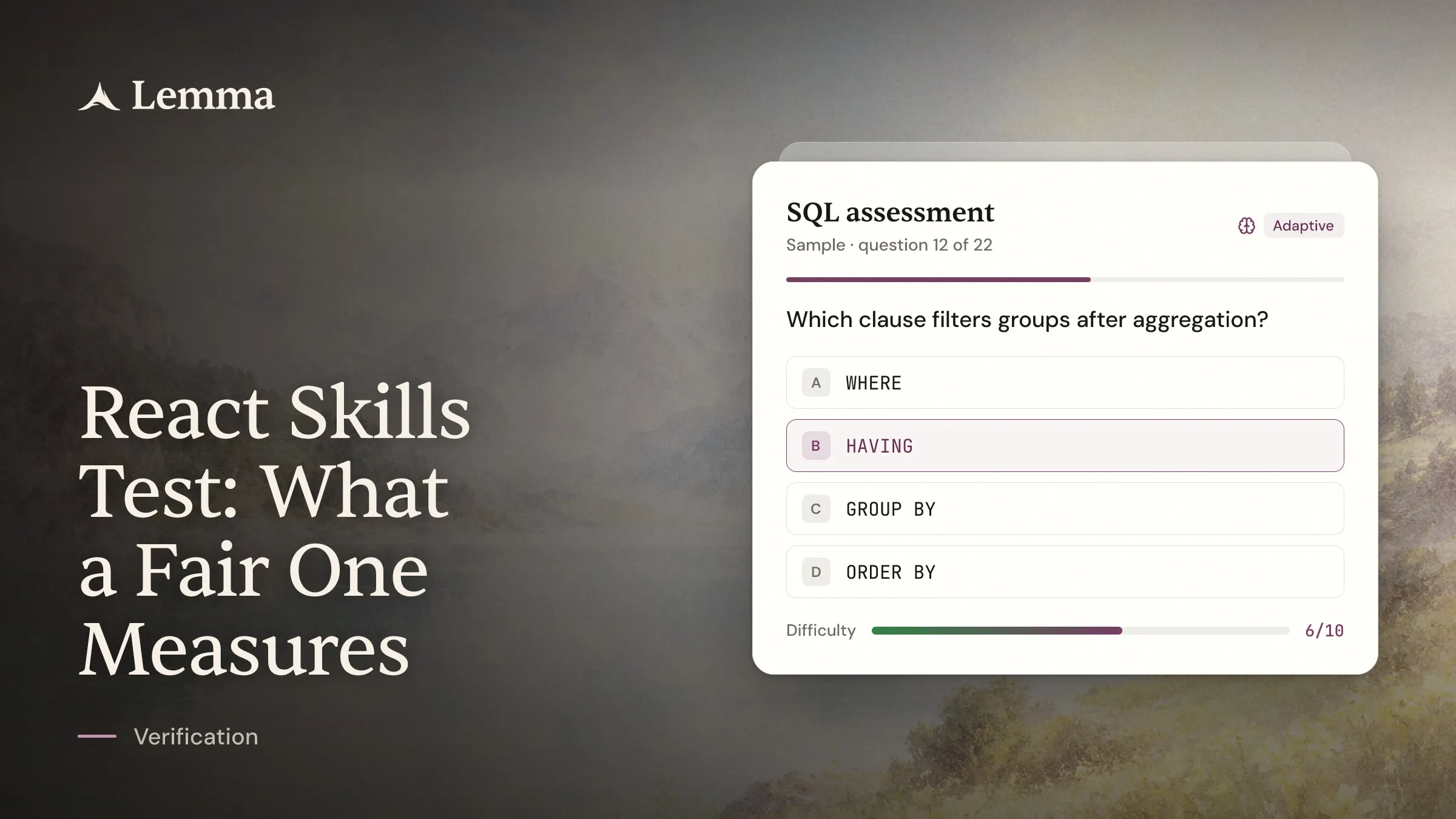
On Lemma, adaptive assessments run on a 1 to 10 difficulty scale and ask between 15 and 25 questions. They stop once your level holds steady, and 6.5 out of 10 passes. Each question is timed and answers cannot be changed afterwards. Each person takes a different path through questions, and tab switches, pastes and developer tools are logged; flags go to a person for review and do not cut a score automatically.

Revenue doubles after joining orders to shipments. What is the most likely cause?
- AOrders with two shipments repeat each row
- BGROUP BY is missing a column
- CLEFT JOIN drops unmatched rows
- DSUM ignores NULL values
On Lemma, sessions are live 30- or 60-minute video sessions booked against one skill. A session completes once both people have joined. Joining more than 15 minutes late counts as a no-show, and cancelling less than 24 hours before the start counts as a late cancellation. Either person can report a session problem, and a Lemma team member reviews it; any correction is added as a new event rather than erasing the record.
If you want the scoring model behind a skill record, /product/sci summarises how SCI is built and what parts it shows.
 ChatGPT
 Claude
 Perplexity